


Fields of activity
Trade and logistics
Cross-border supply, export and shipment organisation.
We treat the line that runs from where a product is made to where it will be used as a whole. Together we look at where demand arises, with whom supply can be set up and by which route the load can reach the point of delivery.
Work topics
Our work topics run along the supply of goods and the carriage of the load. We treat them not separately but as connected links of the same chain.
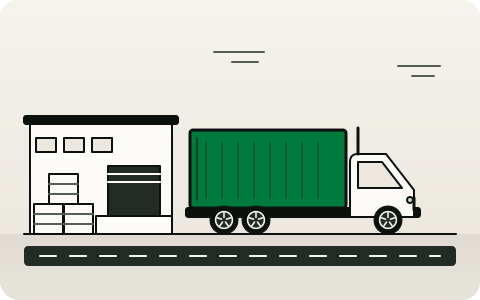
Supply of food, building materials and consumer goods
We look at where a product is made, how it needs to be stored and packed, and where demand generally comes from. By talking with producers and suppliers we assess how the product could cross the border.
- Food
- Building materials
- Consumer goods
Road transport and logistics partnerships
We examine the route, the loading and unloading points, the vehicle arrangement and the flow of documents. Which logistics partnerships would suit the transport is assessed according to the nature of the work.
- Road
- Logistics partnerships
Logistics units
Logistics is more than one road. Alongside land, sea, air and rail, storage, distribution and customs processes are part of the same line. We look at which units come together according to the nature of the job.
Transport modes
The main routes that decide how a load travels.
Road transport
We look at the route for reaching the delivery point by road, the loading arrangement and the paperwork at the border crossing. In this unit, logistics partnerships come to the fore.
Considered together with
- Combined
- Storage
- Heavy loads
Sea transport
We look at which port a load could leave from, how it could be carried by container or in bulk, and how transfer works at the port of arrival. We examine talks with carriers and agents under this unit.
Considered together with
- Storage
Air transport
We evaluate from which airports and with which carriers time-sensitive or low-volume loads could travel. Handling and paperwork at the airport are covered here as well.
Considered together with
- Customs and documents
Rail transport
We look at station and terminal connections, wagon or container options and the transfer points along the line. We examine where rail could meet the other modes.
Considered together with
- Combined
Links and services
Units that join the modes together and that store, distribute and document the load.
Combined (multimodal) transport
We examine cases where a load could travel by a combination of modes instead of a single road. Transfer points, how the load is handed over between modes and the paperwork of each link are considered together.
Considered together with
- Road
- Rail
Storage and bonded warehousing
We look at where the product would wait, how it should be stored and stacked, and whether a bonded warehouse is needed. We treat the warehouse as a waiting and transfer point on the line.
Considered together with
- Road
- Sea
- Distribution
- Cold chain
Distribution and last-mile delivery
We evaluate how the load reaches the recipient from the delivery point, and from which points and with which vehicles distribution could be done. Access and handover arrangements in the last mile are examined separately.
Considered together with
- Storage
- Customs and documents
Organising customs and documentation processes
We examine which documents need to be ready at which stage with a load and who would run the process. Here we look only at the organisation of the process: the order of the documents and how responsibilities are shared.
Considered together with
- Air
- Distribution
- Heavy loads
Topics for special loads
Special transport topics that we also evaluate in the supply of food and building materials. For now they are evaluation topics.
Project and heavy-load transport
In the supply of building materials we treat the carriage of bulky or heavy loads as an evaluation topic. We look at the suitability of the route, of the loading and unloading points and of the vehicle arrangement.
Considered together with
- Road
- Customs and documents
Cold-chain transport
In the supply of food we treat the carriage of temperature-sensitive products as an evaluation topic. We examine cold storage, transfer points and how the product could be protected along the line.
Considered together with
- Storage
How the links join
Units are considered as chains, not one by one. The chains below are illustrations only; a chain changes with the job.
- Sea
- Storage
- Road
A load arriving by sea, waiting in a warehouse and continuing by road is planned as one chain.
- Rail
- Combined
- Road
On lines that join rail and road, the transfer point and the handover of the load are examined separately.
- Air
- Customs and documents
- Distribution
For a load arriving by air, the customs process and the distribution point are handled together.
- Customs and documents
- Heavy loads
- Road
For a heavy load, the customs process and the road route are not thought of apart.
- Cold chain
- Storage
- Distribution
In the cold chain, storage and distribution are treated as linked steps rather than separate ones.
Stops along the line
A supply line looks like a straight stroke, yet every stop has its own questions. We divide the line into stops and look at each one in turn.
Demand
We try to understand where and in what form the product is needed, and how regular that need generally is. The line starts from the answer to that question.
Supply
We look at who the product can be bought from, under which conditions and in what packaging. Talks with producers and suppliers begin at this stop.
Transport
We assess the route, the vehicle, the loading arrangement and the flow of documents at the border crossing. Alongside road, sea, air and rail are options at this stop too; which one to use, and with which partnership, depends on the nature of the work.
Delivery
We clarify where, to whom and under what conditions the load is to be delivered. Storage and distribution at the delivery point are also part of this stop.
The questions we look at
When we assess a supply or shipment idea we work through the headings below. The questions change from case to case; the framework stays the same.
Route and access
We look at which roads reach the point of delivery, how the border crossing works and whether alternative routes exist.
Storage and infrastructure
We focus on where the product will wait, how it needs to be kept and whether the loading and unloading facilities are suitable.
Documents and approvals
We examine which documents and approvals need to be settled at which stage and with which authority, and who will take responsibility for it.
Operating model
We assess who will carry out the transport, storage and coordination, and how responsibilities will be shared between the parties.
Partners and demand
We examine the producers, carriers and local businesses, where demand generally comes from and where supply can be met.
Risks
We assess what could go wrong along the route, in supply and at delivery, and which measures could be considered against it.
How we work
For every new project we first examine the need, the investment conditions and the operating model. Depending on the nature of the work, we meet with investors, producers and local businesses.
Need
We clarify which product is needed, where and for what purpose.
Investment conditions
We outline, in general terms, the resources, permits and infrastructure required.
Operating model
We design who will run the line and how responsibilities will be shared.
Meetings
Depending on the nature of the work, we talk with investors, producers and local businesses.
Decision and roadmap
With what comes out of the meetings, we decide together on the next step.
Frequently asked questions
Which products do you work on?
Our work topics cover the supply of food, building materials and consumer goods. If you have an idea beyond these, we can assess it according to the nature of the project.
Which transport modes and logistics units do you work on?
We evaluate road, sea, air and rail transport, as well as combined transport, storage, distribution and the organisation of customs and documentation processes. Project and heavy-load transport and cold-chain transport are also among our evaluation topics for food and building materials.
How do you approach road transport?
We examine the route, the loading arrangement, the flow of documents and how responsibilities are shared. Logistics partnerships are assessed according to the nature of the work.
What is useful to mention when sharing a supply idea?
The kind of product, from which region to which region it would go, the general frame of demand and the partnership model you are looking for make a sufficient start. We can clarify the details you do not yet know together.
How does the process work after a proposal is shared?
We examine the information shared in terms of the need, the investment conditions and the operating model, and then, depending on the nature of the work, we meet with the parties. This is an evaluation process.
Do you have a supply or shipment idea?
To help us evaluate your investment, supply or joint-project proposals, you may share the location and scope of the project and the kind of partnership you are looking for.
Partnership and contactLocation
Where the product is bought and where it is going.
Scope
Which product, in what volume and how often.
Partnership model
Options such as supply, transport or a joint operation.